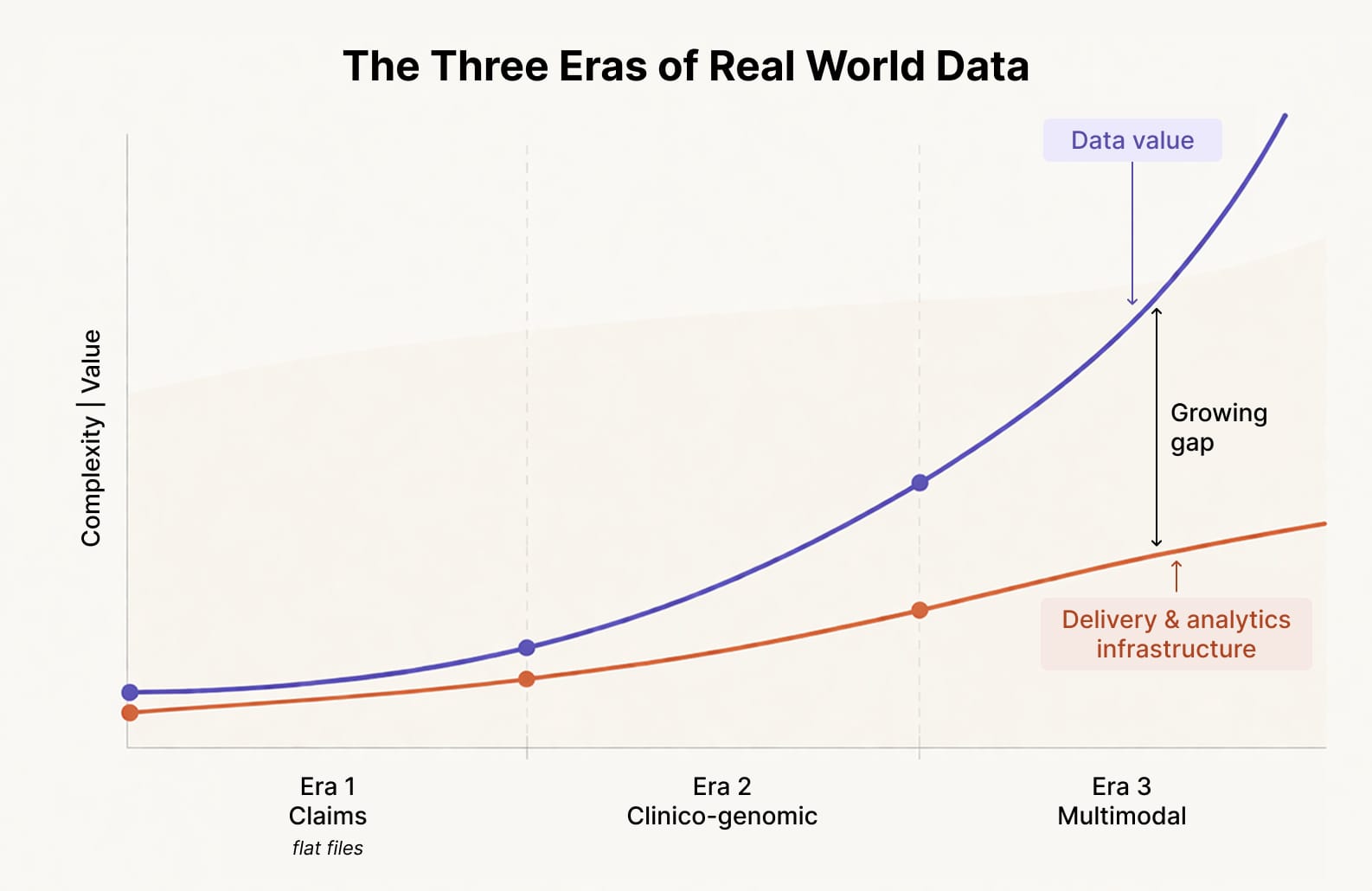
Real World Data Evolved. Data Partnering Infrastructure Hasn’t.
For data producers building the next generation of life sciences assets, the delivery model is now the constraint.
The latest in Manifold updates, press releases, and coverage in the news.


For data producers building the next generation of life sciences assets, the delivery model is now the constraint.
.png)
How data producers can let research partners explore their data, without the risk.
.png)
How data producers can let research partners explore their data, without the risk.

Three takeaways from the Precision Medicine World Conference in Silicon Valley: why the agentic AI revolution in life sciences is just getting started, how clinical foundation models are becoming real, and why staying close to customers still matters most. Reflections from conversations with researchers, builders, and data teams shaping what comes next.

Three takeaways from the Precision Medicine World Conference in Silicon Valley: why the agentic AI revolution in life sciences is just getting started, how clinical foundation models are becoming real, and why staying close to customers still matters most. Reflections from conversations with researchers, builders, and data teams shaping what comes next.

Most life sciences organizations assume that because they generated their data, they control it. That assumption is worth stress-testing. In an AI-driven data economy, legal ownership and practical control are not the same thing — and the gap between them is where long-term value is quietly won or lost.

Most life sciences organizations assume that because they generated their data, they control it. That assumption is worth stress-testing. In an AI-driven data economy, legal ownership and practical control are not the same thing — and the gap between them is where long-term value is quietly won or lost.

Insights from DataDrivenPharma reveal a clear shift in life sciences: AI is moving beyond experimentation toward practical, team-centered workflows that enhance expert decision-making rather than replace it. The future lies in narrow, transparent agents, deeper domain expertise, and scaling pilots into responsible, production-ready systems that unlock real scientific impact.

Insights from DataDrivenPharma reveal a clear shift in life sciences: AI is moving beyond experimentation toward practical, team-centered workflows that enhance expert decision-making rather than replace it. The future lies in narrow, transparent agents, deeper domain expertise, and scaling pilots into responsible, production-ready systems that unlock real scientific impact.

Progress in understanding breast cancer has been limited by the lack of accessible normal breast tissue. The Komen Tissue Bank at Indiana University Melvin and Bren Simon Comprehensive Cancer Center uniquely fills this gap as the world’s only repository of normal breast tissue from healthy volunteers. Through its partnership with Manifold, this resource will become broadly accessible as a global breast cancer research commons.

Progress in understanding breast cancer has been limited by the lack of accessible normal breast tissue. The Komen Tissue Bank at Indiana University Melvin and Bren Simon Comprehensive Cancer Center uniquely fills this gap as the world’s only repository of normal breast tissue from healthy volunteers. Through its partnership with Manifold, this resource will become broadly accessible as a global breast cancer research commons.

The new funding cements Manifold’s leadership in the $2 trillion life sciences market, powering next-generation AI workflows from early discovery through precision care.

The new funding cements Manifold’s leadership in the $2 trillion life sciences market, powering next-generation AI workflows from early discovery through precision care.

Life sciences has never had more powerful tools—yet progress is slowing when it should be accelerating. Manifold’s CEO lays out why this gap exists, how vertical AI can close it, and what our Series B enables as we build the platform to move the field forward.

Life sciences has never had more powerful tools—yet progress is slowing when it should be accelerating. Manifold’s CEO lays out why this gap exists, how vertical AI can close it, and what our Series B enables as we build the platform to move the field forward.
.png)
Foundation Medicine announced a partnership with Manifold to bring artificial intelligence (AI)-enabled analytics to FoundationInsights®.
.png)
Foundation Medicine announced a partnership with Manifold to bring artificial intelligence (AI)-enabled analytics to FoundationInsights®.

In a recent Nature Custom Media webcast, produced by Manifold, leaders from the American Cancer Society (ACS) joined forces to discuss how a trusted research environment is helping to overcome these obstacles, and accelerating the pace of discovery.

In a recent Nature Custom Media webcast, produced by Manifold, leaders from the American Cancer Society (ACS) joined forces to discuss how a trusted research environment is helping to overcome these obstacles, and accelerating the pace of discovery.

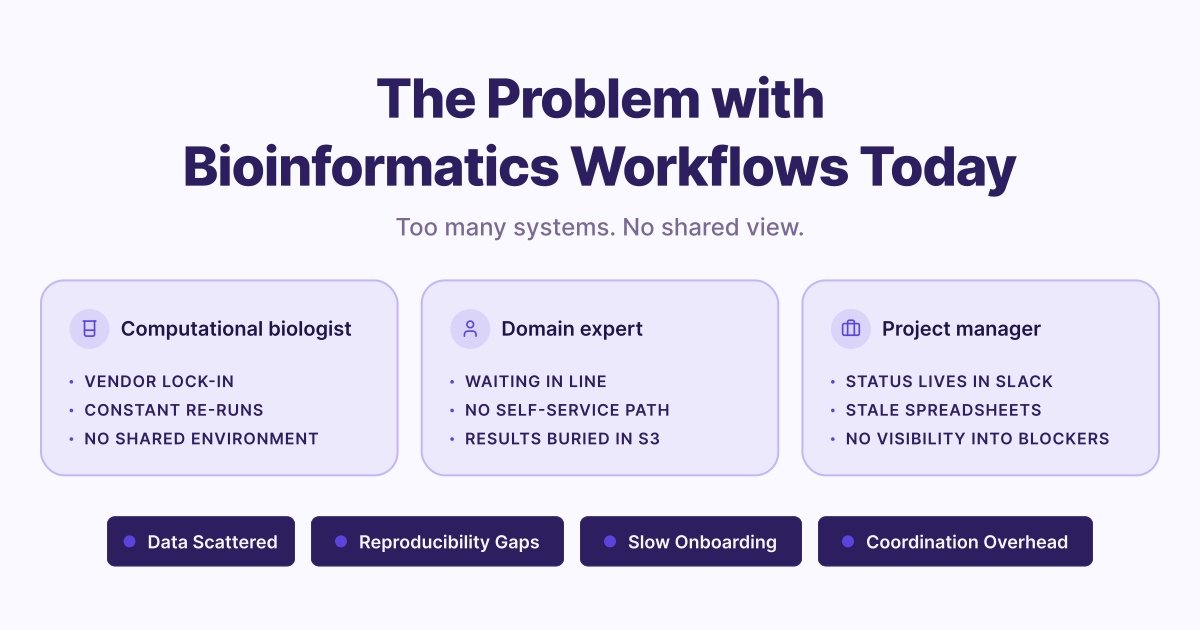
Most platforms weren’t built for bioinformatics. Manifold supports unified data, reusable pipelines, and built-in governance—so scientific teams can work faster, collaborate securely, and trust their infrastructure.

Most platforms weren’t built for bioinformatics. Manifold supports unified data, reusable pipelines, and built-in governance—so scientific teams can work faster, collaborate securely, and trust their infrastructure.

Combining high-volume, diverse data from multiple sources may unlock previously unattainable insights. The challenge is to ensure that the job of harmonizing and accessing these datasets — and enabling reproducibility — is not a barrier to discovery.

Combining high-volume, diverse data from multiple sources may unlock previously unattainable insights. The challenge is to ensure that the job of harmonizing and accessing these datasets — and enabling reproducibility — is not a barrier to discovery.

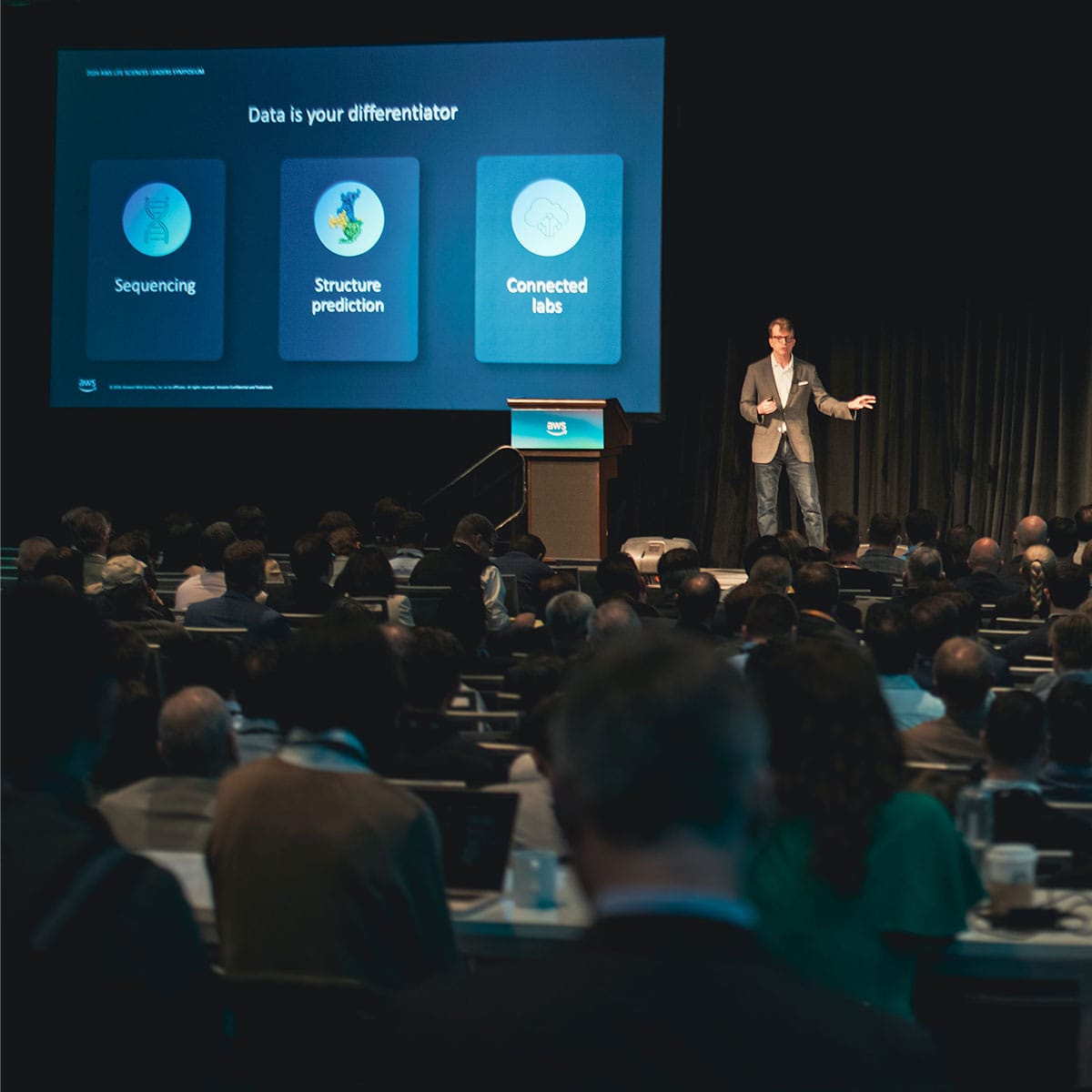
At the AWS Life Sciences Symposium, Broad Institute, AWS, and Manifold AI announced a partnership to transform how researchers access and analyze massive biomedical data. By integrating Broad’s Terra platform with AWS and Manifold AI, the collaboration enables faster, scalable, and more collaborative AI-driven research.

At the AWS Life Sciences Symposium, Broad Institute, AWS, and Manifold AI announced a partnership to transform how researchers access and analyze massive biomedical data. By integrating Broad’s Terra platform with AWS and Manifold AI, the collaboration enables faster, scalable, and more collaborative AI-driven research.
.png)
Manifold, a leading AI-native Trusted Research Environment (TRE) for modern scientific collaboration, today welcomes a group of influential industry veterans to help shape the future of data and AI in life sciences R&D —both as commercial leaders to drive our growth and as visionary customers to inform our platform innovation.
.png)
Manifold, a leading AI-native Trusted Research Environment (TRE) for modern scientific collaboration, today welcomes a group of influential industry veterans to help shape the future of data and AI in life sciences R&D —both as commercial leaders to drive our growth and as visionary customers to inform our platform innovation.
.png)
As the research community continues to rely on data shared by the National Institutes of Health (NIH), ensuring the security of that data continues to be an important requirement. Last year, the NIH issued an implementation update to the NIH Genomic Data Sharing Policy (GDS Policy), which outlines requirements for researchers accessing, storing, or processing large-scale human and non-human genomic data generated from NIH-funded research. The update was designed to continue to promote responsible data management and access under the GDS Policy and ensure the broad and responsible sharing of NIH genomic data for research that advances human health.
.png)
As the research community continues to rely on data shared by the National Institutes of Health (NIH), ensuring the security of that data continues to be an important requirement. Last year, the NIH issued an implementation update to the NIH Genomic Data Sharing Policy (GDS Policy), which outlines requirements for researchers accessing, storing, or processing large-scale human and non-human genomic data generated from NIH-funded research. The update was designed to continue to promote responsible data management and access under the GDS Policy and ensure the broad and responsible sharing of NIH genomic data for research that advances human health.

The Broad Institute of MIT and Harvard is partnering with Manifold to bring a unique life science research and development platform to investigators around the world.

The Broad Institute of MIT and Harvard is partnering with Manifold to bring a unique life science research and development platform to investigators around the world.

When we began exploring the collaboration between Manifold and the Broad Institute, we knew this had to be more than a transactional relationship. From the outset, trust and a shared mission to accelerate the pace of biomedical science guided our efforts.

When we began exploring the collaboration between Manifold and the Broad Institute, we knew this had to be more than a transactional relationship. From the outset, trust and a shared mission to accelerate the pace of biomedical science guided our efforts.
.png)
Strategic collaboration will introduce AI-enabled tools, optimized data sharing, bring your own cloud (BYOC) support, and enhanced scalability
.png)
Strategic collaboration will introduce AI-enabled tools, optimized data sharing, bring your own cloud (BYOC) support, and enhanced scalability

Leading cancer research institute will use Manifold's Cancer Data Science and Observational Study solutions to generate insights from previously siloed data sets

Leading cancer research institute will use Manifold's Cancer Data Science and Observational Study solutions to generate insights from previously siloed data sets

It’s important that we focus attention on the areas where AI is already having a significant impact. These are the practical applications that will allow the best and brightest researchers to focus on science rather than data munging.

It’s important that we focus attention on the areas where AI is already having a significant impact. These are the practical applications that will allow the best and brightest researchers to focus on science rather than data munging.
%20(1540%20x%20513%20px).png)
The landscape of cancer research is rapidly evolving with the integration of multimodal data, including tissue analysis, clinical records, genomic sequencing, and imaging. By harnessing this rich array of cancer-specific data, researchers gain a comprehensive understanding of disease, leading to more accurate diagnoses and personalized treatments.
%20(1540%20x%20513%20px).png)
The landscape of cancer research is rapidly evolving with the integration of multimodal data, including tissue analysis, clinical records, genomic sequencing, and imaging. By harnessing this rich array of cancer-specific data, researchers gain a comprehensive understanding of disease, leading to more accurate diagnoses and personalized treatments.

Join experts from Indiana University, Manifold, and Snowflake for an on-demand eWebinar where you'll learn how to break down data silos, integrate and analyze large-scale clinical and multi-modal data, and collaborate securely with both internal teams and external institutions. Discover how to leverage AI to automate data operations and surface insights faster, enabling more efficient and impactful research.

Join experts from Indiana University, Manifold, and Snowflake for an on-demand eWebinar where you'll learn how to break down data silos, integrate and analyze large-scale clinical and multi-modal data, and collaborate securely with both internal teams and external institutions. Discover how to leverage AI to automate data operations and surface insights faster, enabling more efficient and impactful research.

VOICES of Black Women, the largest population study of Black women in the United States, will be the first of American Cancer Society’s large-scale population studies to be initiated using an AI-driven data management platform—promising to bring observational cancer research out of the age of Excel data files and email sharing.

VOICES of Black Women, the largest population study of Black women in the United States, will be the first of American Cancer Society’s large-scale population studies to be initiated using an AI-driven data management platform—promising to bring observational cancer research out of the age of Excel data files and email sharing.

By year's end, staff expect to see a reduction in time spent on manual tasks and a reduction in duplicative research data generation leading to an overall reduction in ongoing operational costs.

By year's end, staff expect to see a reduction in time spent on manual tasks and a reduction in duplicative research data generation leading to an overall reduction in ongoing operational costs.

Observational studies are pivotal in driving cancer breakthroughs, providing insights into the environmental, lifestyle, and genetic factors that influence cancer development and prevention. This real-world data is the cornerstone of targeted prevention strategies, leading to life-saving discoveries.

Observational studies are pivotal in driving cancer breakthroughs, providing insights into the environmental, lifestyle, and genetic factors that influence cancer development and prevention. This real-world data is the cornerstone of targeted prevention strategies, leading to life-saving discoveries.

Manifold, a data platform startup company that supports clinical researchers, recently announced that the American Cancer Society (ACS) will leverage its platform to modernize its population research study management. Manifold CEO Vinay Seth Mohta recently spoke to Healthcare Innovation about the pain points in clinical research his company is addressing.

Manifold, a data platform startup company that supports clinical researchers, recently announced that the American Cancer Society (ACS) will leverage its platform to modernize its population research study management. Manifold CEO Vinay Seth Mohta recently spoke to Healthcare Innovation about the pain points in clinical research his company is addressing.

Leading cancer research institution will use the Manifold Observational Study technology to deliver a better experience for participants, study managers, and principal investigators

Leading cancer research institution will use the Manifold Observational Study technology to deliver a better experience for participants, study managers, and principal investigators
New leaders bring deep industry expertise from former roles at Kyruus Health, Health Catalyst, Glytec, HubSpot, and Veeva

RamaOnHealthcare talks with Vinay Seth Mohta Co-Founder and CEO of Manifold, an AI-powered clinical research platform that streamlines the manual workflows of modern study and data management, enabling researchers to do more high-impact research and collaborations with fewer resources.

RamaOnHealthcare talks with Vinay Seth Mohta Co-Founder and CEO of Manifold, an AI-powered clinical research platform that streamlines the manual workflows of modern study and data management, enabling researchers to do more high-impact research and collaborations with fewer resources.

Initially founded as an AI lab in 2016, startup Manifold is using its AI expertise to modernize the tech infrastructure of clinical research organizations to help accelerate cancer studies.

Initially founded as an AI lab in 2016, startup Manifold is using its AI expertise to modernize the tech infrastructure of clinical research organizations to help accelerate cancer studies.
Time-to-insight… It’s a metric you don’t hear about much. But it’s a lurking factor throttling the rate of scientific progress in cancer research. So what’s holding us back?
Indiana University Melvin and Bren Simon Comprehensive Cancer Center and Winship Cancer Institute of Emory University are among the early adopters of Manifold’s purpose-built platform

Our collaboration with Anthropic brings Claude’s powerful AI capabilities directly to complex life sciences data and tools, helping scientists move faster and unlock new discoveries. Together, we’re uniting Anthropic’s Claude for Life Sciences initiative with Manifold’s AI Data Platform to bring secure and governed access to scientific data, right where research happens.

Our collaboration with Anthropic brings Claude’s powerful AI capabilities directly to complex life sciences data and tools, helping scientists move faster and unlock new discoveries. Together, we’re uniting Anthropic’s Claude for Life Sciences initiative with Manifold’s AI Data Platform to bring secure and governed access to scientific data, right where research happens.

In life sciences IT, the old compromise of slowing research to stay compliant no longer holds true. Modern platforms prove that scientists can pull cohorts, launch analyses, and share results in real time while IT enforces governance, security, and compliance at every step. True self-service now spans the entire research workflow, giving scientists autonomy to move quickly while IT leaders gain confidence that audits, access controls, and certifications are built in from the start.

In life sciences IT, the old compromise of slowing research to stay compliant no longer holds true. Modern platforms prove that scientists can pull cohorts, launch analyses, and share results in real time while IT enforces governance, security, and compliance at every step. True self-service now spans the entire research workflow, giving scientists autonomy to move quickly while IT leaders gain confidence that audits, access controls, and certifications are built in from the start.
.png)
AI will not replace scientists. It will expand the reach, pace, and ambition of science itself. I believe we are on the cusp of a transformation in the way science is done. Just as personal computers changed the way we write and the internet changed the way we collaborate, AI is changing the way we work with data. In biology and medicine, this change is long overdue.
.png)
AI will not replace scientists. It will expand the reach, pace, and ambition of science itself. I believe we are on the cusp of a transformation in the way science is done. Just as personal computers changed the way we write and the internet changed the way we collaborate, AI is changing the way we work with data. In biology and medicine, this change is long overdue.