
Introducing Bioinformatics Workflows
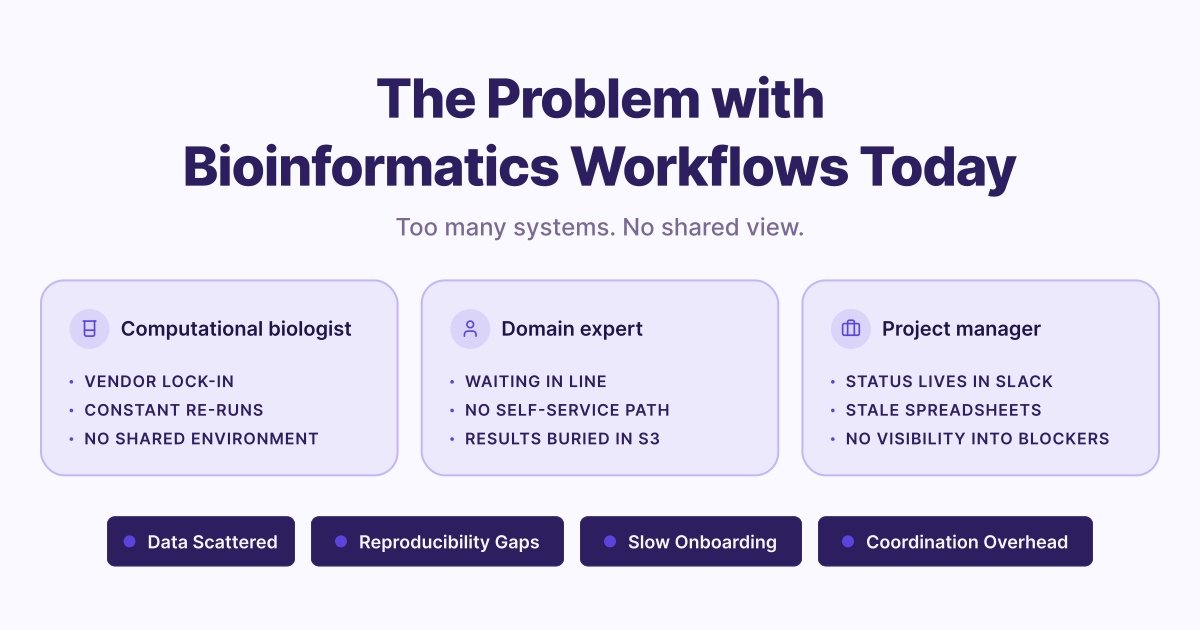
Biomedical research runs on many distinct roles, each with fundamentally different needs from the same platform. For example:
Computational biologists need the flexibility to build, customize, and scale novel methods using their preferred workflow languages, Nextflow and WDL. They can't afford to work around vendor-specific abstractions. Every hour spent translating their methods into a platform's proprietary format is an hour not spent on science.
Domain experts including clinicians, biologists, and study leads need to run established analyses without waiting for a computational team member. They understand the biology. They know which samples to run and why. What they don't always have is command-line fluency, nor should they need it.
Project managers need to know where every sample stands at any given moment: what's been processed, what's pending, what's blocked. Without that visibility, coordination happens over Slack and email, status lives in someone's head, and tracking down a missing result becomes its own project.
These three roles are interdependent, but most platforms treat them as separate audiences.
Tools built for computational power tend to center on pipeline configuration and raw execution. The sample-level and cohort-level context that guides biological interpretation is hidden in a parameter file. Domain experts can't operate in that environment, which means they stay dependent on computational team members for every re-run.
Tools built for accessibility go the other direction: point-and-click interfaces with curated, fixed workflows. They work until a team needs to adapt a method or build something new…then the floor gives out because the flexibility simply isn't there.
The result is fragmentation. Genomic files and methods live in one system, sample metadata in another, status updates in a spreadsheet someone stopped maintaining. Reproducibility suffers. Onboarding new team members is slow. And when something goes wrong mid-study, nobody has the full picture.
Introducing Manifold Workflows: One workbench for the whole team
Manifold Workflows is a bioinformatics environment designed for how research teams actually work. Computational experts build and share methods, domain experts run them independently, and project managers can see project status without asking anyone.
Self-service analysis without sacrificing method quality
The most common bottleneck in bioinformatics is coordination (not compute). Domain experts who need to run a well-established pipeline still have to wait for a computational team member to set it up, configure it, and submit it. Manifold's point-and-click interface is purpose-built to close that gap. Domain experts can import workflows directly from GitHub, S3, or a local machine, configure them through guided setup with automated validation, and submit analyses independently. Computational team members retain full control over method development and can share validated workflow versions to the workbench for broader use, without building a separate interface to do it.
Full project visibility, in real time
Scattered status is a structural problem in most research environments. When sample data, processing history, and results live in different systems, producing a coherent status update requires manual aggregation. Manifold's Analysis Worksheets give every team member a shared, up-to-date view: which samples have been processed, what method was used, where output files live, and what the current status is. Worksheets use a spreadsheet-style interface familiar to non-computational users, integrate directly with workflow submission, and automatically append new outputs as additional columns and rows as runs complete. The project record stays current without anyone maintaining it manually.

Custom methods in a secure, compliant environment
Research teams in regulated environments often face a false choice between scientific flexibility and compliance requirements. Manifold runs custom workflows written in community-standard languages (Nextflow, WDL) on scalable AWS infrastructure, with no vendor-specific logic required. Organizations can configure connectivity preferences for workflow execution to control internet exposure. The platform is SOC 2 Type II, HIPAA, and NIST 800-171 certified, and supports bring-your-own-cloud so teams can run analyses directly against data in their own cloud storage without copying or moving files.
Manifold Workflows is now generally available. If your team is running bioinformatics workflows across mixed technical roles, or struggling with visibility and reproducibility across a study, we want to talk.
Schedule a call with us to learn more.
FAQ
What is Manifold Workflows?
Manifold Workflows is a bioinformatics environment that lets computational biologists build and share Nextflow or WDL pipelines, domain experts run them independently through a point-and-click interface, and project managers track sample-level status in real time — all in one shared workbench.
Does Manifold Workflows require learning a new pipeline language?
No. Manifold runs workflows written in community-standard languages (Nextflow, WDL) as-is, with no vendor-specific reformatting required.