
Your Data Is an Asset. Who Controls Its Future?

Your partners have a checklist. Do you clear it?
Before you offer pharma and biotech partners access to your data, know the security, governance, and capability bar they’ll evaluate you against.
Get the Guide →Most healthcare and life sciences organizations technically own the biological and clinical data they generate. But an important question that is rarely asked: Who controls what can actually be done with it? In an AI-driven data economy, there’s a meaningful difference between legal ownership of data and the practical freedom to create value from it.
Data Generation Is No Longer the Moat - Ownership and Control Is
A decade ago, competitive advantage in life sciences came from the ability to generate biological data at scale. Today, data generation has become accessible and widespread. The new moat is not whether you can produce data, it’s whether you own it, govern it, and control what happens to it downstream.
The value of biological data compounds over time. A dataset generated today for one research purpose may become AI training data in 2027, validate a biomarker in 2029, and underpin a biopharma partnership in 2031. The organizations capturing that value are those that structured their infrastructure to allow it.
What This Looks Like in Practice
Consider how leading precision oncology data organizations have built durable competitive advantage. One major genomic profiling company, now processing hundreds of thousands of patient samples annually, has systematically linked molecular profiles to longitudinal clinical outcomes over more than a decade. That accumulated dataset which is carefully curated, governed, and expanded is now a distinct business asset. This can be licensed to pharmaceutical partners to power insight generation across drug development programs, and is increasingly central to real-world evidence strategies.
A globally recognized genomics research organization offers a parallel lesson. By investing in open, interoperable data infrastructure and maintaining deliberate governance over how its cohorts are accessed and shared, it has become a preferred partner for biopharma and government-funded research programs alike. The datasets themselves, not just the science they enable, have become a strategic asset that attracts collaboration.
A third example: a specialized oncology data company built its business entirely around deeply phenotyped, real-world patient data and not proprietary instruments or lab services. By maintaining full control over the data layer and investing in curation quality, it positioned itself as an indispensable partner for late-stage drug development and regulatory-grade evidence generation.
The common thread is not technology. It is a deliberate decision, made early, to treat data as a strategic portfolio rather than an operational byproduct. In each case, the organizations that made that decision retained the infrastructure architecture to support it.
Integration Offers Convenience. It Can Also Impose Constraints.
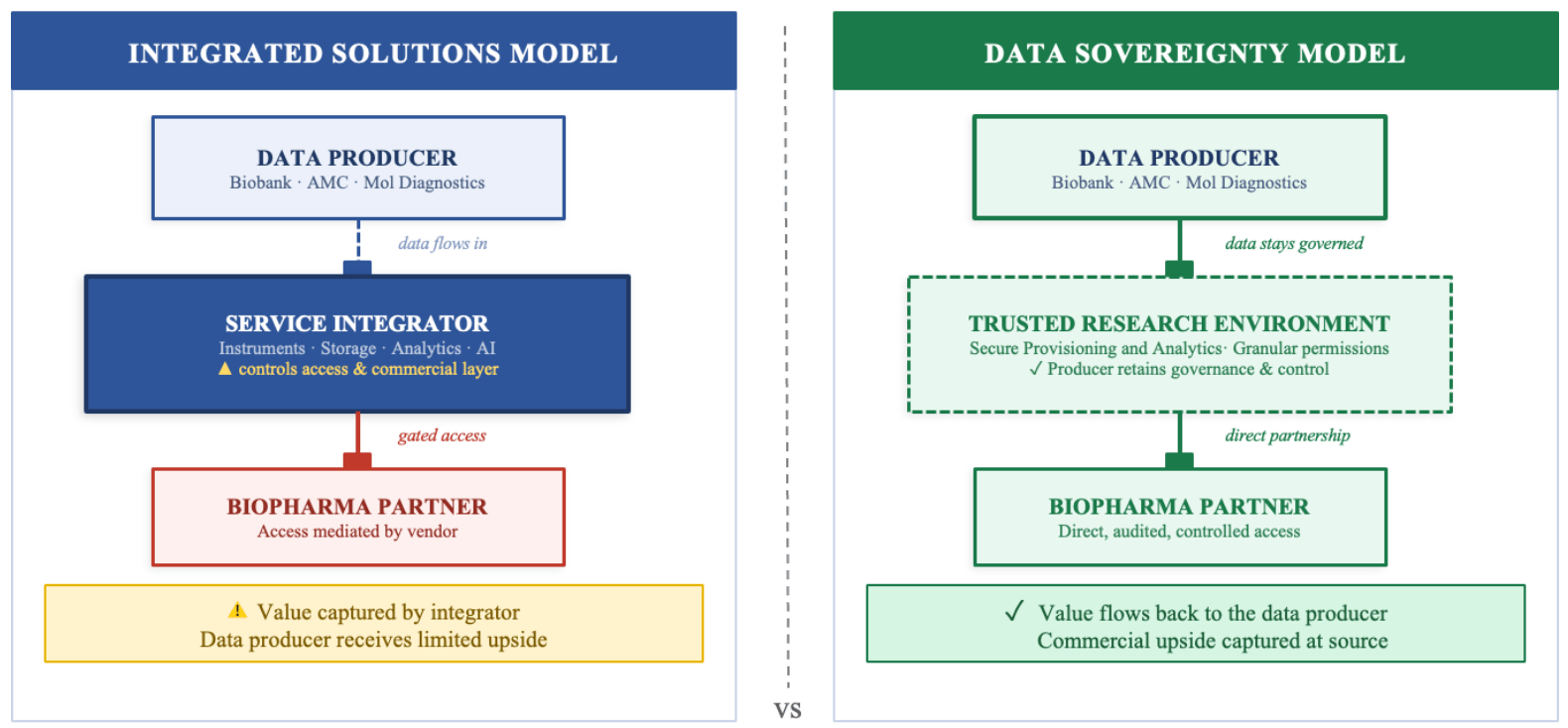
As data infrastructure has consolidated vertically, it has led to bundling of instruments, storage, analytics, and AI tooling through which real operational benefits have emerged. Unified platforms reduce IT overhead, eliminate integration complexity, and accelerate time-to-insight. For organizations with lean teams, these are genuine advantages.
But the terms of that integration matter. Three structural risks are worth understanding:
- Your data may be fueling your vendor’s AI. Service agreements often permit de-identified data to be used for model training and product development. If your datasets are contributing to a vendor’s commercial AI capabilities, you should understand that and whether you’re receiving incremental value in return.
- Commercialization paths can be quietly blocked. When your infrastructure provider sits between you and pharma partners then they may control access layers and audit logs, which means they are not just a vendor. They are a participant in relationships that should belong to you.
- Migration costs are organizational, not just technical. Re-structuring data, rebuilding workflows, and reconfiguring access controls at scale can take years. During that window, funding cycles close and partnerships are missed.
Think Like a Data Asset Manager
The life sciences organizations best positioned for the AI era are evaluating infrastructure the way an asset manager evaluates a portfolio, which means, not just for what it costs today, but for what it enables over the next decade.
Five questions worth asking any platform provider:
- Can I enable external collaboration on this data independently, on my own terms?
- Can I grant differentiated access rights to different partners?
- How easy is it to adopt new analytics tools without rebuilding existing workflows?
- Who captures value when my data contributes to derivative models or products?
- What does migration actually cost if I want to leave?
Your data is more valuable than you think, probably significantly more. The infrastructure decisions you make today will determine whether that value compounds for you over the next decade, or for someone else.
Want to explore what a data strategy built for long-term value looks like? We’d welcome the conversation.