
Introducing Preview Mode
.png)

For organizations sitting on valuable clinical and genomic datasets, the path from “we have data that could accelerate R&D” to “we have a partnership in place” has always been riddled with a frustrating paradox. To close a licensing deal, you need to showcase your data. But having a research partner view all of your data is exactly what you can't afford to do until the deal is closed.
This is the data licensing catch-22. It's been quietly killing deals, stalling partnerships, and leaving revenue on the table for diagnostics companies, molecular Commercial Research Organizations, Real World Data providers and research organizations for years.
In short: Preview Mode gives data producers a way to let potential partners explore a dataset's shape and depth — dashboards, cohort filters, aggregate stats — without exposing underlying files or raw records until a license is signed.
The Problem: Two Parties, Two Frustrations
For Data Producers
You've spent years building a proprietary dataset. It has breadth, depth, and real scientific value. Pharma companies and research organizations want access to it. The interest is there.
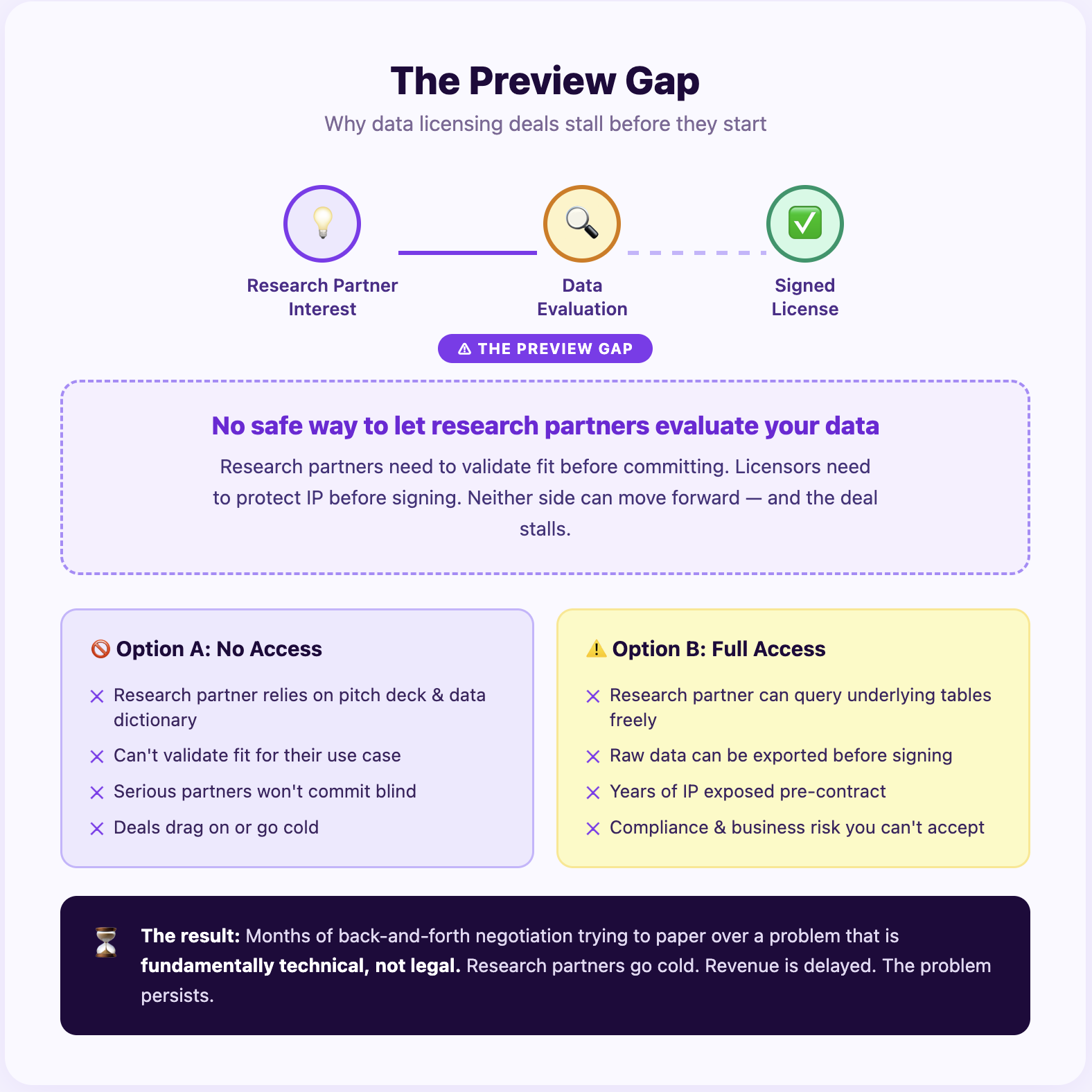
But when it comes time to let a research partner actually evaluate your data, you're stuck between two uncomfortable options:
Give them no access at all, and ask them to make a significant licensing commitment based on a pitch deck and a data dictionary. Most serious buyers won't do it, and they shouldn't have to. They need to validate your data fits their use case before they can justify the investment.
Or give them full access, and risk exactly what you've been protecting all along. A research partner with full platform access can query your underlying tables, download files, and export raw data. All before a contract is signed. That's an IP risk, a compliance problem, and a business vulnerability you can't accept.
The result? Deals drag on. Potential partners go cold. Your team spends months in back-and-forth negotiations trying to paper over a problem that is fundamentally technical, not legal.
For the Potential Data Consumer
The frustration runs in both directions. If you're a pharma scientist, a translational researcher, or a data strategy team evaluating a dataset for a specific program, being asked to commit to a licensing deal without hands-on exploration is a significant ask.
You have real questions that a data dictionary can't answer:
- Does this dataset have sufficient representation in the patient populations you're targeting?
- Are the biomarkers and clinical variables you need actually present and in enough depth?
- Does the data set fit with your planned analysis, and how you plan to extract insights from it?
Without the ability to explore, filter, and interact with the data yourself, you're essentially buying blind. That leads to delayed decisions, additional rounds of due diligence, and quite often a deal that never closes because the uncertainty never fully resolves.
Introducing Preview Mode
Preview Mode is a new dataset access level that gives data producers a secure, purpose-built way to let potential research partners explore their data before a license is signed.
It's a controlled, interactive preview experience. Research partners get enough access to genuinely evaluate the dataset. Data owners retain complete protection of their underlying data.
What Preview Mode Enables
With Preview Mode, data owners can invite potential research partners into a curated environment where they can:
- Explore published dashboards: View and interact with dashboards showcasing aggregate statistics, cohort demographics, biomarker distributions, and more
- Query cohorts in Cohort Explorer: Apply filters, explore subpopulations, and see aggregate-level insights about the dataset
- Understand data coverage: Get a genuine feel for the richness, breadth, and structure of the data before committing
And critically, here's what Preview Mode does not allow:
- Querying underlying dataset tables from compute environments
- Downloading or exporting files
- Exporting data from Cohort Explorer
- Drilling down to row-level data in dashboards
The controls are enforced at the platform level, not managed through an honor system or legal language alone.
Key Benefits
For Data Producers: Accelerate Your Sales Cycle
When research partners can explore your data interactively, the conversation changes. You move from pitching to demonstrating. Research partners can validate data fit on their own timeline, and arrive at licensing conversations with far more confidence and specificity. That means shorter sales cycles, fewer stalled deals, and a better partner experience that reflects well on your organization.
For Data Producers: Protect What You've Built
Preview Mode was designed with data security and IP protection as the foundation, not an afterthought. Granular access controls are enforced at the dataset level, so you can grant preview access to a specific research partner without opening up any other part of your platform. Every preview interaction happens within a governed, auditable environment.
For Data Consumers: Evaluate Before You Commit
For licensing research partners, Preview Mode changes the dynamic entirely. Instead of making high-stakes decisions based on documentation alone, you can interact with the actual data. Explore cohorts, apply your own filters, and validate that the dataset meets your needs. Better information leads to faster, more confident decisions.
A New Standard for Data Licensing
The data licensing market is maturing fast. Organizations with valuable proprietary datasets are increasingly being asked to operate with the rigor and customer experience of a commercial data product. That means giving buyers what they need to make real decisions, without compromising the asset you've built.
Preview Mode is built for exactly that moment: the space between "we're interested" and "we're ready to sign," where deals are won or lost.
Show your data's value. Protect what makes it valuable.
To learn more about Preview Mode and how it can support your data licensing workflows, book a few minutes with us!
FAQ
What is Preview Mode?
Preview Mode is a dataset access level that lets data producers invite potential research partners into a curated environment to explore aggregate dashboards, cohort filters, and data coverage before a licensing deal is signed — without exposing underlying tables, raw files, or row-level data.
What can't a partner do in Preview Mode?
Partners can't query underlying tables from compute environments, download or export files, export data from Cohort Explorer, or drill into row-level data in dashboards. Every control is enforced at the platform level, not managed through contracts or an honor system alone.
