
Make your life sciences data queryable, governed, and ready to share
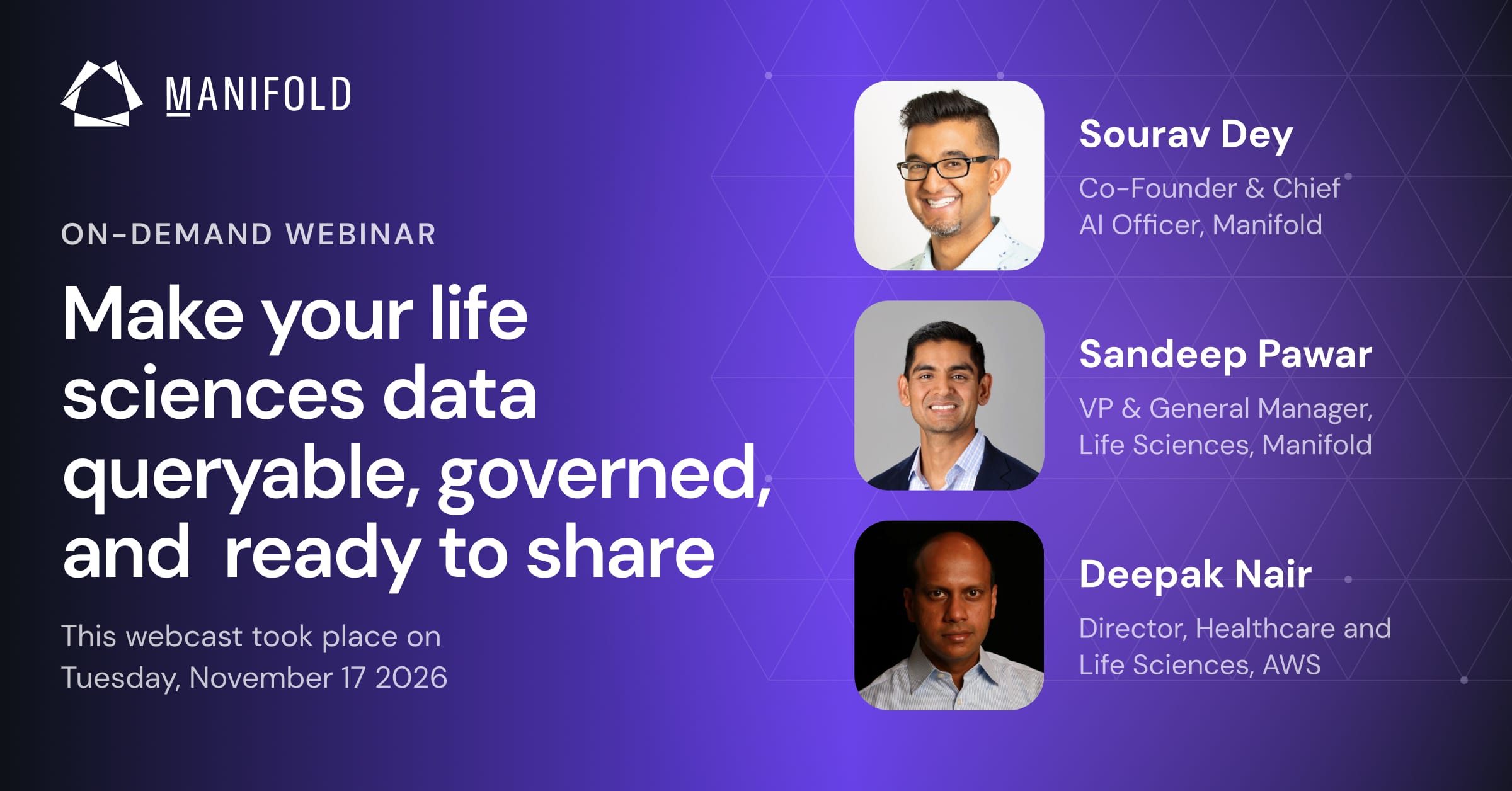
This webcast took place on:
Whether you’re a real world data provider, academic medical center, research institution, health system, or payer, data commercialization may look different for you. Join this on-demand webinar co-hosted by Manifold and AWS for a practical look at how you can turn data you already own into a repeatable revenue line. Learn what data commercialization looks like, why it’s hard, and how to get started wherever you are in your journey today.
Meet the Speakers
 Sourav DeyCo-Founder & Chief AI Officer, Manifold
 Sandeep PawarVP & General Manager, Life Sciences, Manifold
 Deepak NairDirector, Healthcare and Life Sciences, AWS
The demand for life sciences data has never been higher, and neither has the bar for delivering it.
Biopharma is under pressure to get more out of their R&D investment and shorten development timelines. Those that find the right patients and prove value fastest come out ahead. To get there, they need multimodal real-world data they can query and analyze right away, not a data file that takes months to turn into evidence.
Biopharma buyers will pay for speed to insight, and the organizations that can deliver it have a new revenue line. As grants and operating funding tighten, revenue from data you already own matters more than ever.
Most life sciences organizations are not set up for this. Data sits in silos, every data request becomes a custom build, and a feasibility question can take days to answer. Internal stakeholders expect governed access that protects privacy and IP without rebuilding the platform for every new partner. As a result, it often takes six to twelve months to get from first conversation to first insight.
Turning one-off data pulls into repeatable revenue takes a governed platform that makes fragmented life sciences data research-ready, enforces permissions and audit trails automatically, and uses specialist agents to handle analysis that once required a dedicated data team.
Watch this on-demand webinar in which Manifold’s Sourav Dey (Co-Founder & Chief AI Officer) and Sandeep Pawar (VP & General Manager, Life Sciences) and AWS’s Deepak Nair (Director, Healthcare and Life Sciences) explain how life sciences organizations are building recurring revenue from data they already own by making it available to partners without giving up control.
In this webinar you will learn about:
- The four models of data commercialization and the effort, control, and payoff each one involves
- The key requirements to turn one-off data pulls into a repeatable revenue line
- How to answer feasibility questions during a buyer call, run governed trials, and ship datasets with agents that analyze them
- A clear first step, whether your data is siloed or ready to share at scale